

Summarize using AI





Listen to this article
A Sneak Peek
Instagram marketing for restaurants is a practice of using posts, Reels, Stories, location tags, and ads to help nearby diners discover a restaurant.
Also, these marketing elements build trust for the brand, and that gets translated into an order.
The entire process of social media marketing becomes smoother when food-led video, searchable captions, and accurate location data lead to a clear next step, such as online ordering or a catering enquiry.
Also, Instagram now has around 3 billion monthly active users. So, the process of reaching out to the real diners or customers near a restaurant becomes more challenging.
You have to fill the tables, and for that, the scale of Instagram alone is not enough.
In this social media guide, I have combined survey data, recent platform changes, and a real launch campaign to show what actually drives results.
How Important Is Instagram As A Platform For Restaurant Discovery?
Instagram is important for restaurant discovery as part of a wider discovery journey.
In July 2024, a Toast Survey of 850 US adults using social media weekly revealed some interesting facts.
- 28% of users always check the social media profile of a restaurant before dining there.
- 62% said they sometimes check a restaurant’s social media before dining.
- However, only 19% named Instagram as their main discovery channel, and 58% said they use search engines more often than social media to find new restaurants.
- Also, younger diners prefer Instagram more compared to older adults for restaurant discovery and decision-making.
- 27% of 18- to 24-year-olds and 27% of 25- to 34-year-olds used it most.
There are also some similar Canadian data points.
DoorDash Canada’s 2025 report, based on 2,189 consumers, found Instagram was the leading social channel for discovering restaurants (17%), ahead of Facebook (13%), YouTube (12%), and TikTok (9%).
It also found that 49% of Canadians have ordered a trending restaurant item they saw on social media, rising to 72% among Gen Z.
Furthermore, Restaurants Canada reports that 31% of Gen Z and 27% of Millennials find new restaurants on Instagram.
Overall, the practical reading is that Instagram is the place where many diners discover, validate, or shortlist restaurants.
So, the Instagram profile of a restaurant must answer questions like “What is this place?” “Where is it?” and “What should I order?” in seconds.
What Type Of Instagram Content Works Best For Restaurants?
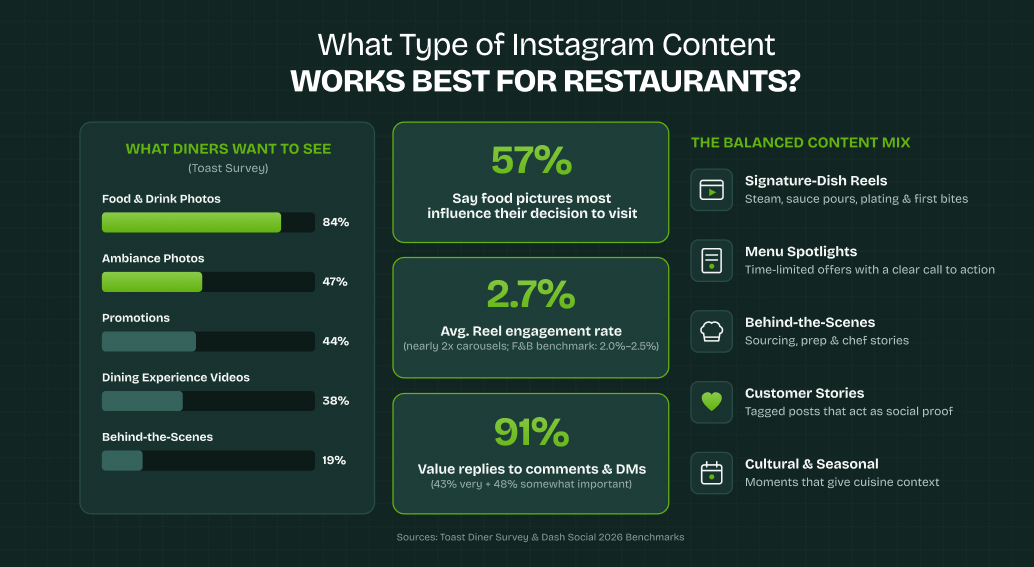
Food-first visuals, if possible in motion, work best for restaurants.
The Toast survey found 84% of diners prefer to see photos of food and drinks on a restaurant’s page, and 57% said food pictures most influence their decision to visit.
Ambiance photos (47%), promotions (44%), videos of the dining experience (38%), and behind-the-scenes footage (19%) followed.
The format of the Instagram post is also important.
For example, Dash Social’s 2026 benchmarks put a healthy Instagram engagement rate for food and beverage brands at 2.0% to 2.5%.
Also, its cross-industry data shows Reels earning a 2.7% engagement rate, nearly double that of carousel posts.
Responsiveness counts as content, too. 43% of Toast’s respondents said it is very important for restaurants to reply to comments and messages, and another 48% said it is somewhat important.
Overall, a balanced restaurant content mix usually covers the following.
- Signature-dish Reels like steam, sauce pours, plating, and first bites.
- Menu spotlights and time-limited offers with a clear call to action.
- Behind-the-scenes sourcing, prep, and chef stories.
- Customer stories and tagged posts that act as social proof.
- Cultural or seasonal moments that give the cuisine context.
How Do Restaurants Optimise Instagram For Search And AI Answers?
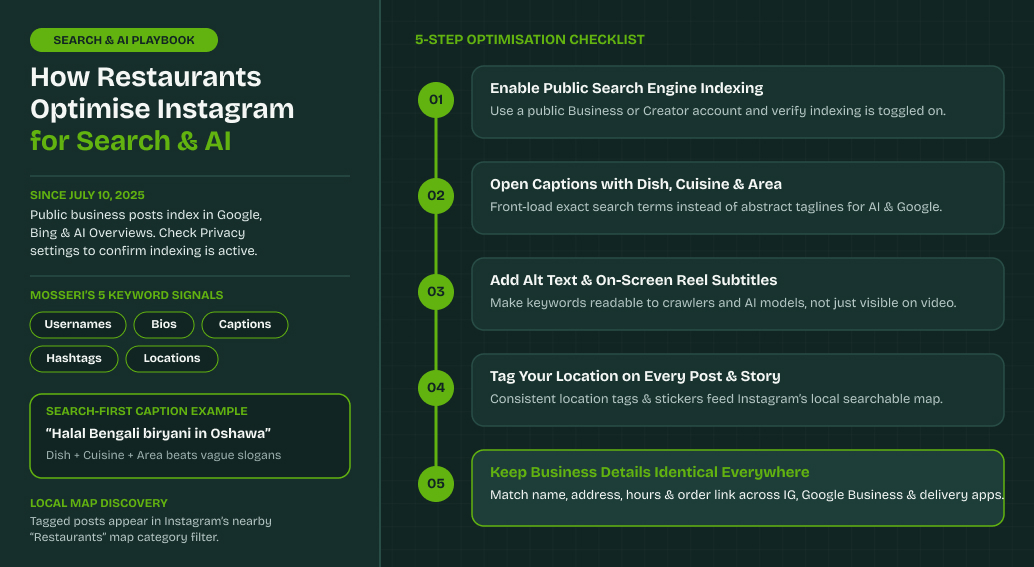
Restaurants or marketers can optimize their Instagram profiles by writing captions, bios, and alt text the way people search.
From 10th July 2025, Instagram allowed search engines to index public posts from professional accounts held by adults.
So, an Instagram Reel can now surface in Google or Bing, and in many cases, these reels are featured in Google AI overviews.
Instagram head Adam Mosseri has said the keywords people type into search are the most important ranking factor, matched against usernames, bios, captions, hashtags, and locations.
However, Instagram has since adjusted its indexing controls. So, you must check the current setting in your privacy menu.
The location of a restaurant also plays an important role, as Instagram’s searchable map lets users filter nearby places by category, including restaurants, and public posts with location tags or stickers can appear on it.
Here is a practical checklist to follow to optimize Instagram for a business.
- Use a public Business or Creator account and check that search engine indexing is switched on.
- Open captions with the dish, cuisine, and area, such as “halal Bengali biryani in Oshawa”, rather than a vague tagline.
- Add alt text and on-screen text or subtitles to Reels so keywords are readable as well as visible.
- Tag your location on every post and Story.
- Keep your name, address, hours, and ordering link identical across Instagram, Google Business Profile, and delivery apps, so search and answer engines can verify them.
What Does An Instagram Funnel Look Like For A Restaurant?
| Stage | Instagram Tactic | What to Track |
|---|---|---|
| Discover | • Keyword-Rich Reels • Location Tags • Creator Collaborations | • Reach • Views • Follower Growth |
| Trust | • Menu Highlights • Behind-the-Scenes Content Replies to Comments | • Saves • Shares • Replies |
| Convert | • Link in Bio to Ordering • Offers • Catering Calls to Action • Promo Codes | • Profile Visits • Link Taps • Code Redemptions |
| Retain | • Tagged Customer Posts • Community Polls • Festive Menus | • Repeat Orders • Tagged Posts |
Case Study: How Viacon Built Shaad-e-Bangla Demand Before Opening
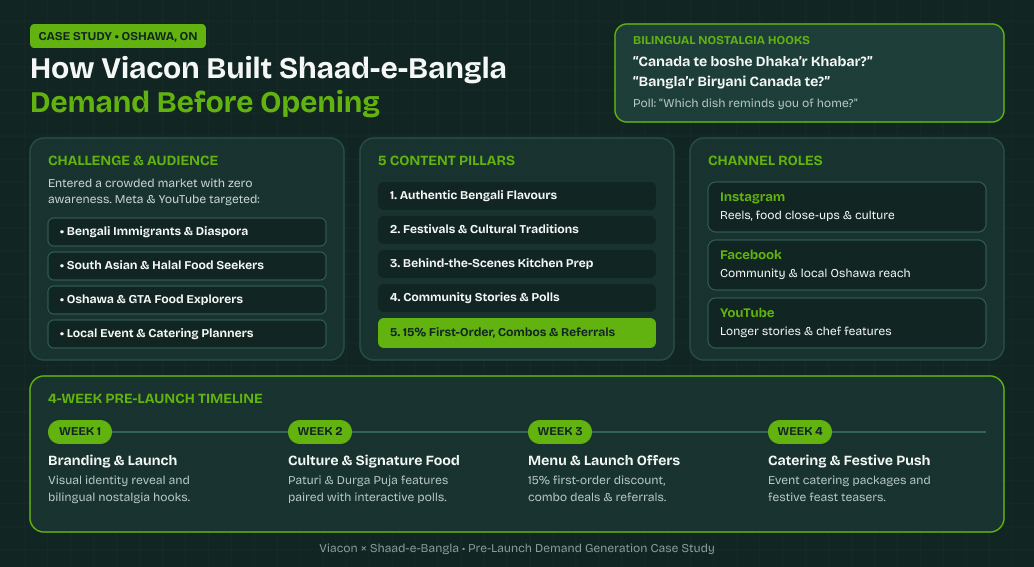
Shaad-e-Bangla is a Bengali and Bangladeshi takeaway restaurant in Oshawa, Ontario. Viacon partnered with it as a launch partner to build the brand and its digital presence ahead of opening.
The challenge was familiar to any new restaurant.
The core challenges were no awareness, a crowded food market, and an audience spanning Bengali immigrants, the Bangladeshi diaspora, wider South Asian communities, and local food explorers.
- Viacon built the strategy on five content pillars.
- Authentic Bengali flavours
- Festivals and traditions
- Behind-the-scenes
- Community stories and offers.
Also, each social media platform had a defined role.
Instagram carried visual storytelling through Reels, food close-ups, and cultural moments.
Facebook handled community and local reach, and YouTube hosted longer stories and chef features.
Creative used culturally specific, bilingual hooks such as “Canada te boshe Dhaka’r Khabar?” and “Bangla’r Biryani Canada te?”, which spoke directly to diaspora nostalgia.
A four-week plan moved from branding and launch to culture and food (including Paturi and Durga Puja content).
Then, it highlighted the menu and offers (a 15% first-order discount, combo deals and referral rewards), then catering and festive teasers.
Moreover, polls and prompts like “Which dish reminds you of home?” invited participation.
On the other hand, Meta and YouTube campaigns targeted Bengali and South Asian audiences, halal food seekers, Oshawa and GTA food lovers, and event planners.
In addition, as the brand was new, all the metrics at the beginning of the campaign and with the successful execution of the plans, Viacon helped Shaad-e-Bangla achieve the following numbers.
| Platform | Impressions | Engagement | Visits | Followers/Subscribers |
|---|---|---|---|---|
| 60K | 1.7K | 1.8K | 180 | |
| 68.1K | 620 | 5.4K | 142 | |
| YouTube | 8K | 119 | 1K | 14 |
What These Figures Mean?
Instagram’s 1.7K engagements on 60K impressions works out to roughly 2.8%.
That is our own calculation, and it sits above the Dash Social food and beverage range, though the metrics are defined differently, so treat it as indicative.
The business impact mattered more here. The campaign generated catering enquiries and orders, and the restaurant received multiple calls asking about its opening date before it launched.
The lesson for other restaurants is that a clear cultural identity, a defined role for each platform, and offers that give followers a reason to act can create demand before the doors open.
The appetite for the cuisine is real. Chicken biryani, butter chicken, and naan were all among the top 10 dishes ordered on DoorDash in Canada in 2024.
What Mistakes Should Restaurants Avoid On Instagram?
Most underperforming restaurant accounts share the same gaps.
The first is posting attractive food with no conversion path. So, interested diners find no ordering link, menu, or phone number.
The second is generic captions that give neither Instagram search nor Google anything to match.
The third is ignoring comments and DMs, even though Toast’s data shows diners notice responsiveness.
The fourth is promotion-only feeds.
Toast’s respondents were nearly as interested in ambiance (47%) as in offers (44%).
So, a feed of discounts alone misses what builds trust. Finally, many restaurants never review performance, so they keep repeating formats that earn little.
Instagram rewards restaurants that are specific: a clear cuisine, searchable captions, accurate locations, and content that makes the next step obvious.
The data shows diners still use search engines and other platforms too, so treat Instagram as the place where interest is built and validated, then make ordering effortless.
Instagram Marketing For Restaurants: Frequently Asked Questions
Here are the frequently asked questions and answers about Instagram marketing for restaurants.
How Can A Restaurant Measure Instagram’s Impact On Sales?
A restaurant can measure Instagram’s impact on sales with trackable offers.
Toast suggests giving influencers unique discount codes so redemptions show which partnerships drive footfall and sales.
The same approach works for Stories, bio links, and Reels calls to action, using a dedicated code or ordering link for each.
Should Restaurants Work With Food Influencers?
Yes, restaurants should work with food influencers to reach out to younger audiences.
Toast found that 40% of diners base decisions on an influencer’s review, and DoorDash Canada found 62% of Gen Z and 49% of Millennials trust restaurant influencers, versus 20% of Baby Boomers.
However, choose creators whose audience matches your neighbourhood and cuisine.
Is Instagram Or TikTok Better For Restaurants?
TikTok is banned in India. So, for an Indian restaurant catering to Indians, Instagram is a better choice.
However, in a scenario where both platforms work, the choice depends on the age of the diner.
In Toast’s survey, 41% of 18 to 24-year-olds used TikTok most for discovery, falling to 23% for ages 25 to 34 and 7% for those over 54.
In Canada overall, DoorDash found Instagram (17%) ahead of TikTok (9%). Start where your core customers are, then repurpose Reels.
Should Restaurants Focus On Reels Or Direct Messages?
Restaurants should focus on both Reels and direct messages.
Mosseri said in 2025 that Instagram’s growth has been driven by DMs, Reels and recommendations, and that the app would be reoriented around them.
Reels earn reach; DMs are where reservations, catering enquiries, and order questions land, so reply quickly.

SIBASHREE BHATTACHARYA
AuthorSibashree has been into SEO and eCommerce content writing for more than 9 years. She loves reading books and is a huge fan of those over-the-top period dramas. Her favorite niches are fashion, lifestyle, beauty, traveling, relationships, women's interests, and movies. The strength of her writing lies in thorough research backing and an understanding of readers’ pain points.
View All Posts