

Summarize using AI




Listen to this article
A Quick Overview
Once a B2B cybersecurity brand has established its credibility through organic strategies, paid social media advertising helps to amplify it.
In my ten years in social media, I have rarely seen this sequence demonstrated as cleanly as in the MSOLS International case study from Viacon.
I was part of the team, and Viacon ran a sustained LinkedIn campaign for MSOLS International for three to four months.
The result?
- 320K+ Impressions
- 96K+ Reach
- 3.8K+ Clicks
- 110+ Business Enquiries.
Here is more about what was done, what the numbers mean, and what other B2B cybersecurity brands can get inspired by.
What Does Paid Social Advertising Mean For A B2B Cybersecurity Brand?
Paid social advertising means that you pay a platform to show your content to a defined audience beyond your followers.
For MSOLS, that translated into making its content visible to IT, security, and business decision-makers on LinkedIn through paid promotion.
Cybersecurity is a high-trust, long-cycle purchase.
So, the ads had to do two jobs. They had to reach the right roles and give them reasons to trust a name they may not have met.
Why Was An Organic-First Approach Important?
The sequence of social media marketing for MSOLS International by Viacon was deliberate.
The first, or organic, phase covered event storytelling, a newsletter series, trend-led posts, and solution content on AISOC™ and CRP.
Along with brand awareness and credibility building, this organic strategy increased the LinkedIn following of MSOLS from 111 to 1,055.
This number boost gave the paid phase something credible. Anyone clicking an ad would find a profile with substance rather than an empty page.
Why Was LinkedIn The Right Platform?
MSOLS, being a B2B cybersecurity service, sells its products to businesses or organizations and not consumers.
LinkedIn is the platform that allows advertisers to target by job role and industry.
That precision matters when your buyer is an IT head or security lead rather than a general audience.
LinkedIn is not the cheapest channel per lead, so precision has to justify the spend.
How Did Viacon Structure The Paid MSOLS LinkedIn Campaign?
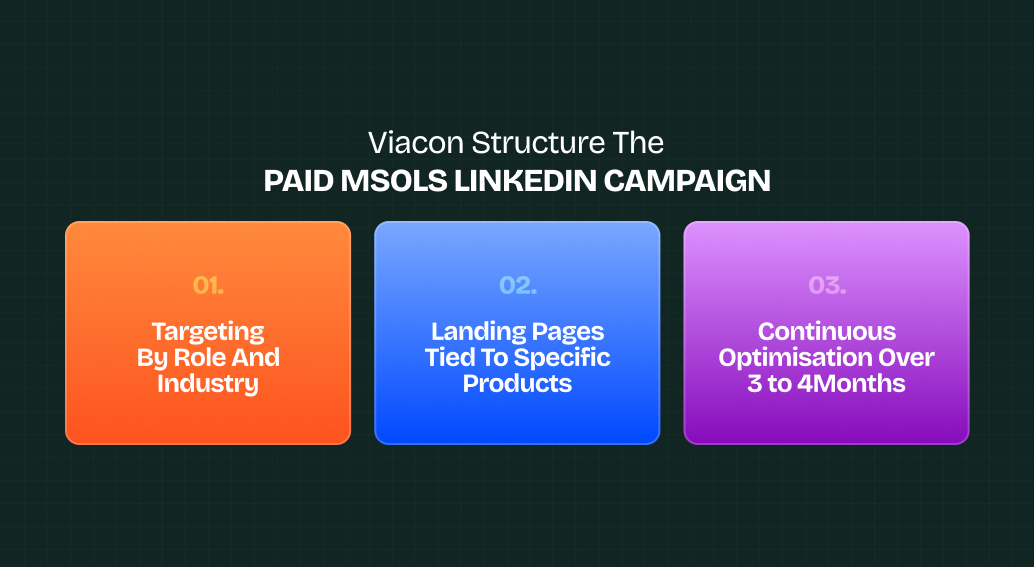
The three most important parts of the paid LinkedIn marketing strategy of MSOLS International were targeting by role and industry, typing landing pages to specific products, and continuous optimization.
Any one of them, done badly, would have wasted budget.
Targeting By Role And Industry
The campaigns reached the following industries and roles.
- IT
- Security
- Business Leaders.
As cybersecurity is a critical area of service, a click from the wrong job title is a cost, not a win.
So, tight targeting protects the budget even before a single creative is tested.
Landing Pages Tied To Specific Products
Viacon did not channel traffic to a generic homepage of MSOLS International.
It pointed clicks to solution pages for AISOC™, MSOLS’s enterprise security offering, and CRP, built for small and mid-sized organisations.
Matching the ad to one product page keeps the message consistent from the feed to the form.
Continuous Optimisation Over Three To Four Months
The team monitored and refined creatives, messaging and audience sets, tracking reach, engagement, clicks and leads throughout.
The long run matters.
B2B buyers rarely act on first sight, and a short burst gives both the algorithm and the marketer too little data to learn from.
Messaging: Turning Technical Products Into Business Value
The paid social media marketing of MSOLS International is an efficient example of how technical capabilities are translated into clear business value.
A technical copy will ask a busy executive to read and decipher the details.
A business-value copy is more direct and highlights the details for them. So, a cold audience on LinkedIn will stop for it.
Benefit-Led Creative For AISOC™
Viacon’s creative portfolio frames AISOC™ around outcomes: round-the-clock AI-powered monitoring, proactive defence, seamless integration, and regulatory readiness.
Then, it closes on the idea that enterprises need speed and AISOC delivers security at scale.
Each phrase answers a question a security buyer already has. So, the ad earns attention without needing a long explanation.
Compliance-Led Creative For CRP
For CRP, the portfolio leans on practical features such as a PDPL assessment tool, audit preparation support, compliance benchmarking, and recommendations for improvement.
For a smaller organisation without a dedicated security team, those read as tasks completed rather than technology explained.
That is exactly the framing a time-poor decision-maker responds to.
What The Numbers Show
The first table lists the results reported.
The second compares ratios I calculated from them against published benchmarks.
| Metric | Reported Result | What it Tells Us |
|---|---|---|
| Impressions | 320K+ | Total times the ads were shown |
| Reach | 96K+ | Unique professionals who saw them |
| Clicks | 3.8K+ | Visits driven to solution pages |
| Engagements | 420+ | Likes, comments, and shares |
| Enquiries/leads | 110+ | Business conversations started |
(Source: Viacon, MSOLS International case study (LinkedIn Ads campaign results).)
| Metric | MSOLS International(Calculated) | Industry Reference |
|---|---|---|
| Click-through rate | About 1.2% | 0.67% LinkedIn median across 153 B2B advertisers in 2025. |
| Click-to-enquiry rate | About 2.9% | 2–4% landing-page conversion in a 2026 B2B SaaS roundup. |
| Frequency | About 3.3 views per person | No standard benchmark. |
| Cost per lead | Not disclosed | $202 LinkedIn median in 2025. |
Expert View: Reach The 95%, Not Just The 5%
Professor John Dawes of the Ehrenberg-Bass Institute, in research for LinkedIn’s B2B Institute, found that only about 5% of B2B buyers are in the market at any time.
Dawes explains that the way advertising works “isn’t by stimulating people to buy.” It builds memory of the brand for later.
That reframes the MSOLS results.
Reaching 96K+ professionals, each seeing the ads about 3.3 times on average, is not mainly 96K sales opportunities.
It is a pool of future buyers who now recognise the name.
The 110+ enquiries are the few who were ready.
For everyone else, it is a memory built for the day a procurement cycle opens.
For a vendor with long buying cycles, I value that second outcome as much as the first.
Common Paid Social Mistakes In B2B Cybersecurity
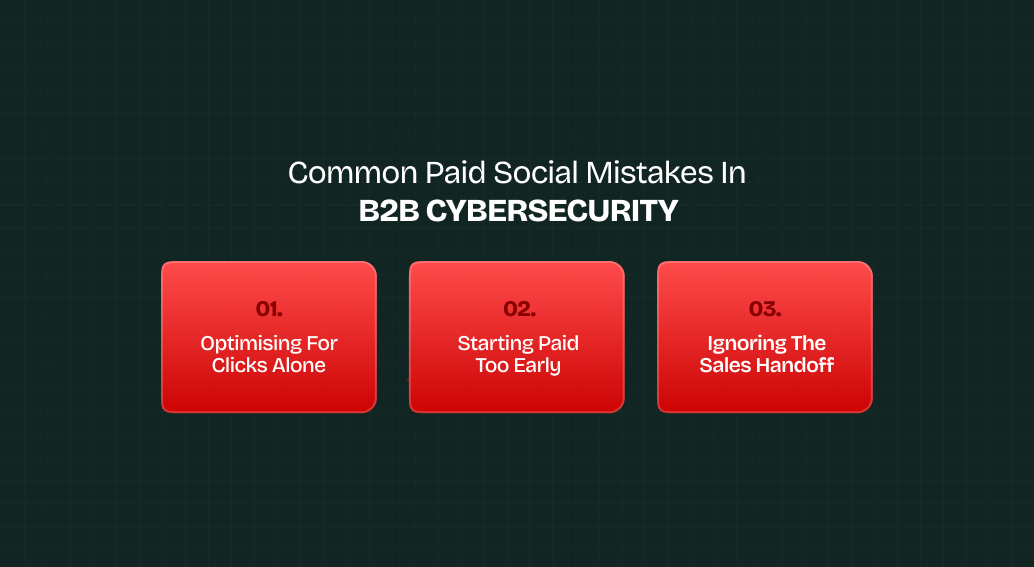
The MSOLS campaign avoided several errors I see regularly when reviewing B2B accounts.
They are worth naming because each one quietly drains budget.
Optimising For Clicks Alone
A high click-through rate with weak enquiries signals curiosity, not intent.
Judge click quality by what happens after the landing page, not by the click itself.
Starting Paid Too Early
Advertising to a thin, inconsistent profile wastes the very attention you paid for.
Viacon’s brand guidelines, content roadmap, and organic groundwork came first for exactly this reason.
Ignoring The Sales Handoff
The case study describes the campaign supporting the sales team with a steady pipeline of prospects.
That only works when sales know how quickly and in what way to follow up.
A lead that waits a week is a lead the next vendor reaches first.
Five Lessons For Other Cybersecurity Brands
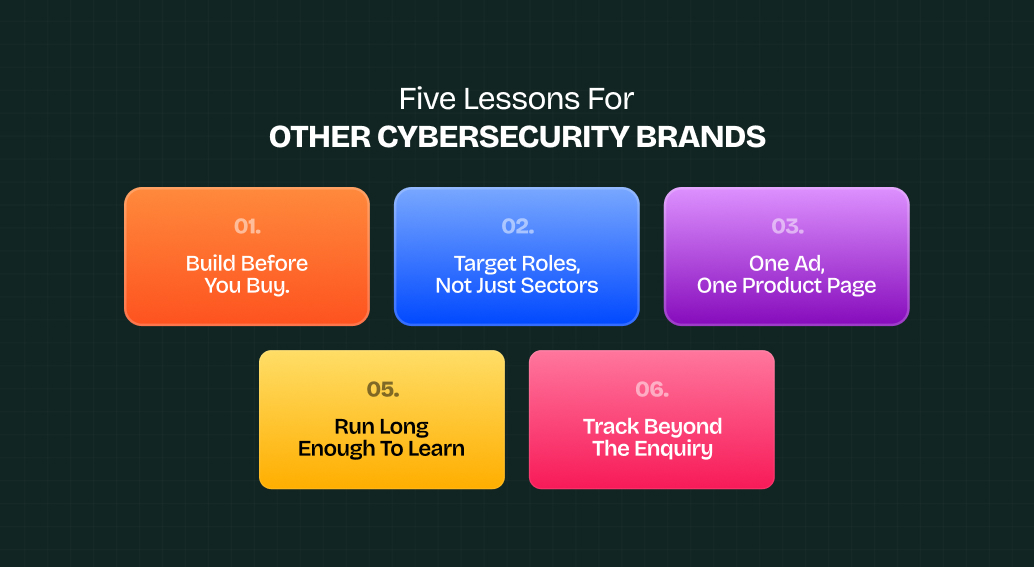
These are the takeaways I would apply to any B2B security or technology account.
| Core Principle | Actionable Strategy | Key Benefit |
| Build before you buy. | Establish organic credibility on your profile before running paid ads. | Ensures ad clicks land on a profile worth trusting. |
| Target roles, not just sectors. | Use specific job title filters rather than broad industry targeting. | Keeps ad budget focused strictly on actual decision-makers. |
| One ad, one product page. | Link each individual ad directly to its dedicated product landing page. | Lifts conversion rates via message match and clarifies the specific offer. |
| Run long enough to learn. | Commit to running campaigns for a 3-to-4-month window. | Allows enough data to properly optimize creative assets and audiences. |
| Track beyond the enquiry. | Follow generated leads all the way through your CRM pipeline. | Reveals the true revenue and ROI earned by the campaign. |
What Did The Paid Social Media Advertising For MSOLS Establish?
The MSOLS International campaign highlights that paid social advertising in B2B cybersecurity is a sequencing problem as much as a budget problem.
Viacon built credibility first, targeted by role, tied every ad to a specific product page, and optimised for months rather than days.
Brands that copy the sequence and measure what happens after the enquiry will get the most from their LinkedIn budgets.
Paid Social Media Advertising: Frequently Asked Questions (FAQs)
Here are the frequently asked questions and answers for paid social media advertising for a B2B cybersecurity business.
Should A Cybersecurity Brand Use Lead Gen Forms Or Landing Pages?
Yes, a cybersecurity brand should use lead-gen forms.
Metadata.io’s 2025 data puts a LinkedIn lead at $193 through a lead-gen form against $346 through a landing page.
Forms are cheaper, but I would check lead quality in your CRM before scaling them.
How Does LinkedIn Compare With Instagram For B2B Paid Ads?
In the same dataset, median cost per lead was $202 on LinkedIn and $138 on Instagram.
Cheaper is not better if the leads do not fit your buyer profile.
So, test Instagram with a small budget and keep LinkedIn for role-based targeting.
Which Metrics Should I Show Leadership?
You must show pipeline-linked metrics, including qualified leads, cost per qualified lead, and opportunities influenced, to your leadership.
Impressions and clicks explain how you got there. However, leadership decisions rest on pipeline and revenue.
Can A Brand With A Small Following Run Effective Paid Social?
Yes, a brand with a small following can run effective paid social.
Paid reach depends on targeting, not follower count.
With about 1,055 LinkedIn followers after its organic phase, MSOLS still reached 96K+ professionals through ads, roughly ninety times its own audience.
The followers mattered mainly as proof of credibility.

SIBASHREE BHATTACHARYA
AuthorSibashree has been into SEO and eCommerce content writing for more than 9 years. She loves reading books and is a huge fan of those over-the-top period dramas. Her favorite niches are fashion, lifestyle, beauty, traveling, relationships, women's interests, and movies. The strength of her writing lies in thorough research backing and an understanding of readers’ pain points.
View All Posts