

Summarize using AI





Listen to this article
Quick Answer:
A social media strategy for restaurants means using platforms such as Facebook, Instagram, TikTok, and YouTube to help nearby diners discover a restaurant.
However, the strategy is not just for restaurant brand discovery. It is also about trusting its food and placing an order. So, it is like a complete journey from discovery to filling tables.
The content you create for social media for restaurants has to be food-focused, locally targeted, and easy to act on.
Also, in 2027, if you are managing social media for restaurants, you need to create a good mix of word-of-mouth publicity, Google Maps, and reviews.
What more do you need to do to bring your A-game in managing social media for restaurants? Let’s decode it with a real example of Shaad-e-Bangla’s success story by Viacon.
Key Takeaways
- At least 88% of Canadian diners occasionally check a restaurant on social media before visiting.
- Multi-channel discovery is real, with word-of-mouth publicity leading at 38%. However, Facebook (27%) is the strongest social platform for US diners.
- Food photos and short videos work best for social media for restaurants. 84% of diners want to see food and drink photos on a restaurant’s page.
- Shaad-e-Bangla, a new Bengali takeaway in Oshawa, generated roughly 136,000 combined impressions across Instagram, Facebook, and YouTube platforms before its doors opened.
Why Is Social Media So Important For Restaurants?
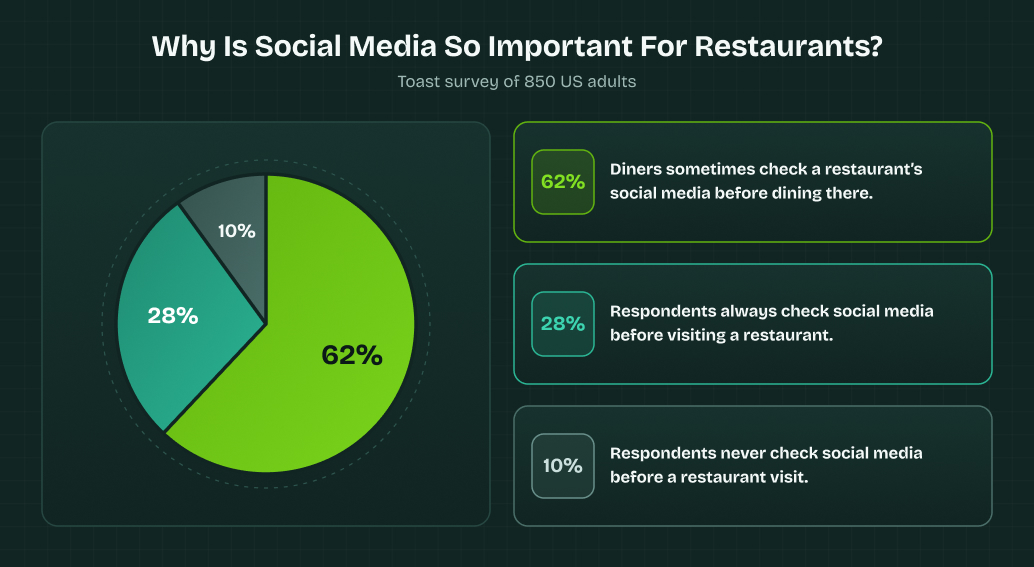
Social media for restaurants is crucial because, according to a Toast survey of 850 US adults, 62% of the diners sometimes check a restaurant’s social media before dining there.
Also, 28% of those respondents said that they always check social media before visiting a restaurant.
Only 10% of the respondents said that they never check social media before a restaurant visit.
Again, I was going through TouchBistro’s 2025 Canadian Diner Trends Report, and it showed how Canadian diners connect more strongly with social media.
A Harris Poll survey of 1,000 diners found that 88% at least occasionally check a restaurant on social media before deciding where to eat.
Now, here you have to note that the diners are deciding to visit a restaurant after checking it out on social media.
So, it is not just about brand discovery but also about taking an action, which is filling the tables or ordering from the restaurant.
DoorDash’s 2025 Canada report also shows some important data. It found that 49% of Canadians have ordered a trending dish from a restaurant after seeing it on social media.
So, social media for a restaurant functions as secondary storefronts, and those are open to diners even before they knock on the actual doors.
How Social Media Fits Into A Larger Marketing Ecosystem
These reports do not mean that social media is the only place that is helping the discovery-to-ordering or discovery-to-visit journeys.
Toast’s 2026 discovery study of 1466 diners found a more diversified picture.
- Word of mouth leads were 38%.
- 30% of diners discovered a restaurant by simply walking or driving past it.
- 27% of the diners got to know about a restaurant from Facebook.
- TV ads and map apps each helped around 18% of respondents discover a restaurant.
- Search engines helped 16% of the diners.
So, social media for a restaurant is an important part of a larger marketing ecosystem. The key here is consistency, as your Google Maps listing, reviews, and social profiles should all tell the same story.
Which Social Media Platforms Work Best For Restaurants?
The best social platform for restaurants depends on the age and location of the user. So, here, the customer demography also plays an important role.
From Toast’s 2024 data, we have the following key data points.
- 80% of Guests over 54 use Facebook to discover restaurants.
- Also, 41% of 18-to-24-year-olds lean on TikTok.
Also, Toast’s 2026 survey shows that urban diners mostly rely on social media to know about restaurants, while suburban diners depend more on word-of-mouth publicity and physical visibility.
| Platform | Best For | Evidence |
|---|---|---|
| • Local Reach • Events • Offers • Community Building | • 27% of US diners discover restaurants on Facebook (Toast, 2026) • 21% of Canadian diners say it influences their choice most (TouchBistro, 2025) | |
| • Food Close-Ups • Reels • Cultural Moments | Top social discovery channel for Canadians at 17%, according to Top social discovery channel for Canadians at 17% DoorDash 2025 Canada Report. | |
| TikTok | • Gen-Z Discovery • Trend-Led Discovery Video | #1 discovery channel for Gen Z at 38% (Toast, 2026) |
| YouTube | • Recipes • Chef Features • Long-Form Stories | • 15% of US diners (Toast, 2026) rely on YouTube. • 12% of Canadians lean on YouTube for restaurant discovery. (DoorDash, 2025) |
What Should Restaurants Post On Social Media?
Social media for restaurants must have food-first posts.
In Toast’s 2024 survey, we can see why these are so crucial.
| Content Type | Diner Metric/Impact | Percentage |
|---|---|---|
| Photos of Food and Drinks | Preferred on a Restaurant’s Page | 84% |
| Food Pictures | Most Likely to Influence a Visit | 57% |
| Decor | Influences a Visit | 47% |
| Promotions | Influences a Visit | 44% |
| Videos of the Dining Experience | Influences a Visit | 38% |
| Behind-the-Scenes Footage | Appeals to Diners | 19% |
Similarly, the DoorDash 2024 Canada report says that one in three consumers makes decisions about where to order for pickup or delivery from food photographs.
Keeping all these data points in mind, a practical content mix for social media for restaurants looks like this.
| Content Category | Key Strategy/Elements | Purpose/Supporting Insight |
|---|---|---|
| Signature Dishes | • Close-ups with Steam • Sauce Pours • A First Bite Shot in Natural Light | Highlights appetizing visuals of core menu items. |
| Offers and Menus | Showcase both pricing/value and food quality | Price/value (55%) and food quality (51%) are the top reasons guests try a new restaurant (Toast 2026 study). |
| Behind the Scenes | Kitchen prep and ingredient sourcing stories | Builds trust even when fewer diners explicitly ask for this content. |
| Guest Stories | Reshared customer posts and reviews | Supplies authentic social proof. |
| Local and Cultural Moments | • Festivals • Community Events • Neighborhood Tie-Ins | Connects the restaurant with the local community and timely events. |
Two More Habits To Develop
Two habits make a strong social media presence different from weak ones.
At first, you have to respond to the posts, as 43% of diners say replying to comments and messages is very important and 48% say it is somewhat important, according to a Toast 2024 survey.
The same survey further highlights, “40% of respondents base their decision to dine at a restaurant on an influencer’s review.”
So, influencer marketing and collaboration are another important practice for social media marketing for restaurants.
How Do Restaurants Turn Social Media Attention Into Orders?
Drawing the attention of diners becomes effective, or it only counts when the next step is obvious.
You can follow this sequence.
- Put the ordering link (website, Uber Eats, DoorDash, or SkipTheDishes) at the top of every profile.
- Pair awareness content with one clear offer, such as a first-order discount or combo, and give it a trackable code.
- Target ads by radius and interest so spend reaches people who can realistically visit.
- Keep hours, menu, and photos identical across Instagram, Facebook, and Google.
- Measure what the business feels, including profile visits, link clicks, redemptions, and call volume, not just likes.
A Real Example: How Did Viacon Build Demand For Shaad-e-Bangla Before Opening?
Shaad-e-Bangla is a takeaway restaurant in Oshawa, Ontario, serving Bengali and Bangladeshi cuisine.
Digital agency Viacon joined as launch partner to build the brand and its social presence before the restaurant opened.
The case shows how the principles above work for a brand-new restaurant serving a specific community.
The Challenge
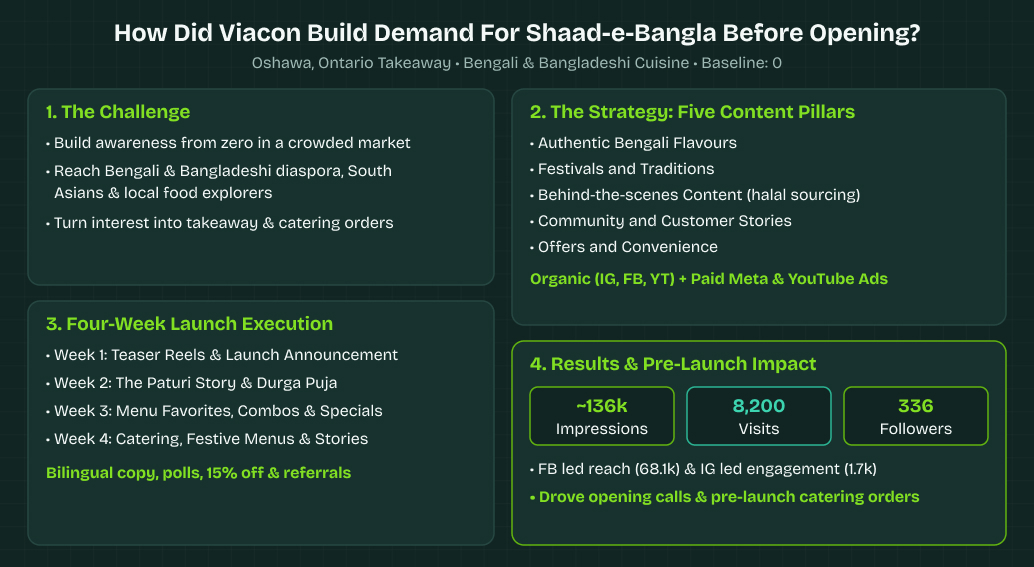
As a new name in a crowded market, Shaad-e-Bangla had to build awareness from zero.
It had to reach overlapping target audiences, including Bengali immigrants from India, the Bangladeshi diaspora, wider South Asian communities, and food explorers.
The bigger challenge was to turn the online interest it created into takeaway and catering orders.
The Strategy
Viacon built the plan around five content pillars.
- Authentic Bengali Flavours
- Festivals and Traditions
- Behind-the-scenes Content (including halal ingredient sourcing)
- Community and Customer Stories
- Offers and Convenience
Furthermore, each of the three social media platforms had a distinct role to play.
Instagram marketing focused on visual storytelling and Reels. Facebook, on the other hand, helped with community building, events, offers, and local reach.
Again, YouTube content had chef features, recipes, and brand journey in the copybook style.
While these were the organic parts, the paid campaigns on Meta were video, carousel, and single-image ads.
On YouTube, it was short-form and skippable in-stream video.
The paid ads targeted the Bengali and South Asian diaspora, halal food seekers, food lovers in Oshawa and the GTA, and event and catering planners.
The Execution
A four-week launch strategy transformed curiosity about Shaad-e-Bangla into conversion.
| Timeline | Focus/Theme | Key Content and Activities |
|---|---|---|
| Week 1 | Brand Introduction | • Teaser Reels • Launch Announcement |
| Week 2 | Culture and Food | • The Paturi Story • Durga Puja Content |
| Week 3 | Menu and Offers | • Menu Favorites • Combo Deals • Takeaway Specials |
| Week 4 | Conversion and Expansion | • Catering • Customer Stories • Teasers • Festive Menus |
The offers for Shaad-e-Bangla included 15% off a first order and referral rewards, while polls, trivia, and prompts such as “Which dish reminds you of home?” invited participation.
The creative leaned on nostalgia and bilingual copy.
One post asked “Canada te boshe Dhaka’r Khabar?” which roughly meant “Sitting in Canada, eating Dhaka’s food?”
Those were very smart, as they were speaking to diaspora diners in their own blend of Bengali and English.
The Results
| Platforms | Impressions | Engagement | Visits | Followers/Subscribers |
|---|---|---|---|---|
| 60k | 1.7k | 1.8k | 180 | |
| 68.1k | 620 | 5.4k | 142 | |
| YouTube | 8k | 119 | 1k | 14 |
(Source: Viacon’s Shaad-e-Bangla performance dashboard. Every pre-campaign baseline was zero.)
So, combined, three social media channels delivered roughly 136,000 impressions, 8,200 visits, and 336 new followers and subscribers (from the totals of Viacon’s figures).
However, the business impact was beyond the dashboard.
The restaurant received multiple calls asking about its opening date before launch, and promotional campaigns generated catering enquiries and orders.
Facebook produced the most impressions and visits, while Instagram produced the most engagement and followers.
That aligns with Facebook’s strength as a local discovery channel in the Toast and TouchBistro data above.
What Other Restaurants Can Learn From The Shaad-e-Bangla Social Media Journey?
The social media marketing moves and results for Shaad-e-Bangla show that you will have to speak the community’s language.
For Shaad-e-Bangla, nostalgia and bilingual copy gave diaspora diners a reason to engage beyond the food.
Also, it is important to allow every social media platform to do its specific job. Facebook can help to reach out to local diners and events, and Instagram could help decision-making and conversions with visual stories.
At the same time, YouTube is well-suited for telling stories in a long format.
In addition, the social media team of Viacon brilliantly built festival content that built affinity, while first-order offers and catering promotions gave it a purpose.
Moreover, you have to start the restaurant campaign well in advance, as the Shaad-e-Bangla example shows how the pre-launch content created demand the kitchen could serve immediately.
What Mistakes Should Restaurants Avoid On Social Media?
| Common Mistakes | Why It Hurts with Supporting Insights | Recommended Approach |
|---|---|---|
| Posting Only Discounts | • 44% of Diners Want Promotions • 84% Prefer Food Photos | Balance promotional posts with appetizing food photography. |
| Recycling One Asset Everywhere | Different channels favor different styles and norms. | Adapt the format and caption specifically to each platform. |
| Ignoring Comments and DMs | Unanswered messages undercut the trust your content builds. | Actively respond to comments and direct messages. |
| Chasing Follower Counts | 31% of diners follow a restaurant after visiting and liking it (Toast). | Focus on delivering a great in-house experience to drive organic social growth. |
And It’s A Wrap!
Social media for restaurants works when it respects how diners actually decide.
They look at the food, check for proof, and want an easy way to order.
Choose platforms by audience, lead with food, answer every comment, and measure orders rather than likes.
As Shaad-e-Bangla shows, even a restaurant that has not yet opened can build a waiting audience with the right pillars.
Social Media For Restaurants: Frequently Asked Questions (FAQs)
Here are the frequently asked questions and answers about social media for restaurants.
How Often Should A Restaurant Post On Social Media?
Consistency matters more than volume when executing the social media plan of a restaurant.
A realistic starting rhythm is three to five feed posts or Reels a week, plus Stories whenever the kitchen has something to show. Increase the number of posts only if they are offering value additions.
Do Small Restaurants Need A Professional Photographer?
No, a small restaurant does not need a professional photographer at first. A recent smartphone, natural window light, and a clean plate are enough to start.
As the business grows, Toast suggests hiring a professional or training staff, since food imagery is what diners respond to most.
How Do I Know Whether Social Media Is Working?
Track numbers tied to the business to find out the performance of social media for a restaurant business.
Track profile visits, link clicks, offer-code redemptions, call volume, and a “how did you hear about us” question at the counter.
Also, follower growth, which Toast cites Sprout Social as treating as a sign of channel health, is a useful supporting metric rather than the goal.
How Should A Restaurant Handle A Negative Comment?
A restaurant must reply to a negative comment publicly and promptly.
You can begin the post by thanking the guest and apologise if there have been genuine quality gaps, and then move the details to a private message.
Offer a calm response and keep it visible so that other diners know how you treat people.

SIBASHREE BHATTACHARYA
AuthorSibashree has been into SEO and eCommerce content writing for more than 9 years. She loves reading books and is a huge fan of those over-the-top period dramas. Her favorite niches are fashion, lifestyle, beauty, traveling, relationships, women's interests, and movies. The strength of her writing lies in thorough research backing and an understanding of readers’ pain points.
View All Posts